
The Apocalyptic Personality
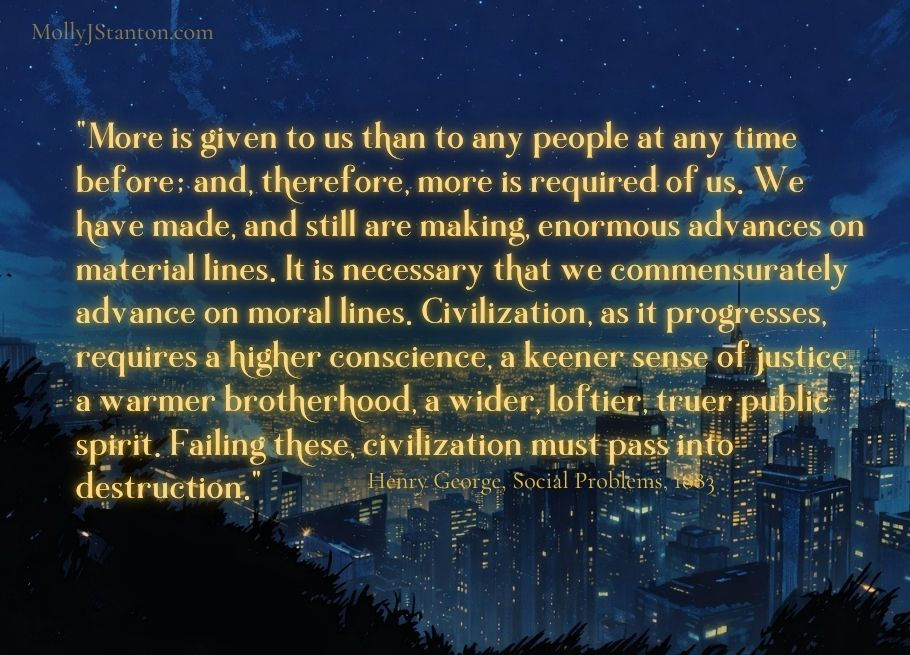
Writing in 1883, Henry George perfectly describes the complete opposite of what our society has become in 2026. In a way it's not our fault. We were never really wired to live like this. Forced from the commons first into the service of Kings and later into factories at the dawn of the Industrial Revolution we've always known by the rising ache of our souls this was a socio-and psychopathic culture.
We are, at the deepest levels of our evolutionary coding, creatures of the small and particular. Paleolithic hunter-gatherer societies are where our social and neural hardware was built. Society at that time existed in tribes of around 150 people, large enough to persist through struggle, but small enough where everyone knew you, so you were accountable to the group. Because survival depended on sharing, equnamity, and mutual responsibility to each other, greed, coveting, and laziness were punished.... hard. Such was the beginning of morality.
The terrible irony of modernity is that, save for a few isolated pockets, we have created a world of billions of strangers scaled beyond the threshold where innate human morality and even mental health functions. Faces blur into statistics, consequence detaches from action, and we are bewildered when people behave as if no one and nothing matters beside themselves.
Even when industrial society was in its infancy, Henry George wrote of this trajectory in his 1883 book Social Problems. He warned us that the sheer size and inventive structures we were building into society would be the very things that led to its fall: a collapsing moral center, a poor sense of justice, private ofer public goods, etc. The quote above rising through the internet wreckage through 140 years lands like prophecy.
The psychologist John F Shumaker has described at length modernity's effect on human behavior. He brings up a very good point, often overlooked in the focus on our suffering mental health under late stage capitalism. We certainly have epidemic levels of mental health and addiction issues, but underneath it all we also have what he calls a 'personality crisis'.
What Schumaker describes is something wrong with personhood itself. Consumer capitalism, he argues, has quietly engineered a type of human being: one shaped less by character than by appetite, less by values than by preferences, less by who they are than by what they buy and how they appear.
The psychologist Erich Fromm, writing fifty years before Schumaker, already saw it coming and called it the 'marketing personality'. Such a husk of a person functions like a brand instead of someone with a soul. The marketing personality lacks the interior depth that moral reasoning and sense of accountability to the group. This person is highly adaptable, almost a different person depending on the situation. And, of course, is extremely materialistic.
Capitalist culture produces mostly these hollow personalities. They're the parade of influencers filling your Instagram feed. The Joneses you are implored to keep up with. They're two billionaires trying to out-do each other with their rockets and ridiculous plans to colonize Mars. Tempting to call them vapid, stupid, or evil.
But they are none of those things. They're simply unfinished. Adults in years who remains, in the ways that matter most, children: easily distracted, allergic to sacrifice, most comfortable when consuming and most lost when asked to really contribute. And a civilization run by, and for, unfinished people cannot hold. And perhaps most troubling for this moment as the current order collapses under its own weight, can only think in terms of dystopias.
Shumaker describes our hordes of perpetual adolescents who can't imagine society other than what it is or as a dystopia as the 'apocalyptic personality'. He says:
"Who we are has never been more incompatible with who we need to be. What we have become is the greatest threat to ourselves and the planet. We have been perfectly groomed, psychologically and spiritually, for disaster. We have become hard. We are the people of the apocalypse."
******
On balance, as a therpist, I agree with Shumaker's diagnosis of the problem. Those who know me well would never have the temerity to accuse me of being an optimist, but I think he gives up all hope. Without cause. There are many inspiring responses arising all over the world to our present polycrisis.
I believe it's our job as writers and creatives to dig ourselves out of dystopia and apocalypse becoming our only imagined future. Before a society can shift, it must first imagine something different. That's literally our job. Myth always arrives before politics.
So as I write the next and last two books in my series, I am fictionally confronting this unfinished capitalist personality. What kinds of experiences would shatter this person, but in a way that who they became on the other side of such an initiation is exactly who we need to transition into a more life-affirming healthy society? Who would be the elders who can contain that rupture so it does not destroy the accidental initiates?
I have some ideas....


Comments